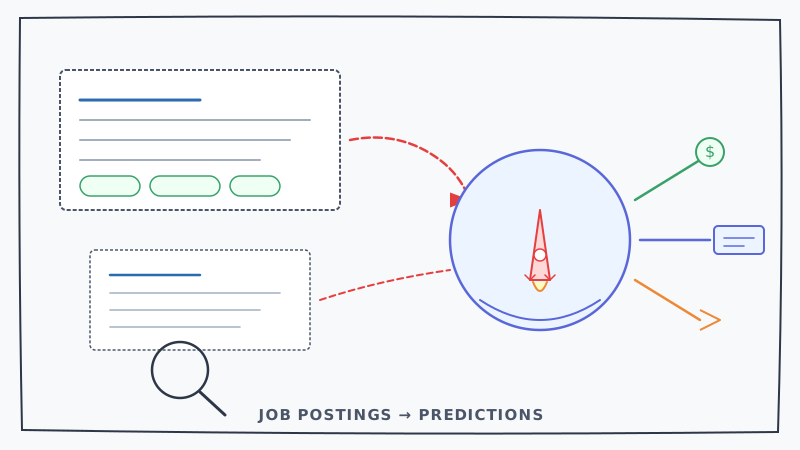
A company can keep its product roadmap secret. It can embargo press announcements, lock down beta programs, and swear its employees to NDAs. But it cannot hire in secret. Every open role is a public declaration of intent, posted on LinkedIn, career pages, and job boards for the world to see.
The problem is that most competitive intelligence programs treat job postings as background noise. They track press releases, product updates, and pricing changes. They monitor social media and analyst reports. But they overlook the single most honest signal a company produces: the specific skills, roles, and team structures it is willing to pay for.
This guide breaks down how to systematically monitor competitor job postings, decode the skill sets and role patterns that predict upcoming launches, and turn that intelligence into a strategic advantage your team can act on.
The Predictive Power of Job Descriptions
Press releases are crafted by marketing. Roadmap slides are aspirational. But job descriptions are written by hiring managers who need someone to do a specific job. They contain technical requirements, tool preferences, domain expertise, and team context that reveal exactly what a company is building.
Consider the difference between these two signals:
A competitor’s blog post says: “We are investing in next-generation analytics capabilities.”
Their job posting says: “Senior Data Engineer with experience in Apache Flink, real-time streaming pipelines, and sub-second query latency for dashboards serving 10K+ concurrent users.”
The blog post tells you nothing actionable. The job posting tells you they are building a real-time analytics product designed for high-concurrency enterprise use cases. It tells you the technology stack. It tells you the scale they are targeting. And it tells you this 4 to 8 months before the feature ships.
Why 4 to 8 Months?
The typical timeline from posting a role to product launch follows a predictable sequence:
- Weeks 1 to 6: Role is posted and candidates are sourced
- Weeks 6 to 12: Interviews, offers, and notice periods
- Months 3 to 5: New hire ramps up, joins the team, begins contributing
- Months 5 to 8: Feature is built, tested, and launched
This means the job posting appears publicly at the very start of that cycle. By the time you see the posting, the product decision has already been made internally, budget has been allocated, and the company is committed. You have a window of several months to prepare your response before the market feels the impact.
Five Job Posting Patterns That Predict Market Moves
Not every open role is a signal. Companies always have some level of backfill hiring. The key is to identify patterns, specifically clusters of related roles that point toward a strategic initiative.
Pattern 1: New Role Categories That Never Existed Before
When a competitor posts its first-ever “Machine Learning Engineer” role, that is not backfill. That is a new capability being built from scratch. First-time role categories are the strongest predictive signal because they represent a deliberate decision to invest in something the company has never done before.
Watch for:
- First AI/ML engineering roles (new product capabilities)
- First Developer Relations or Developer Advocate roles (platform or API play)
- First compliance or security engineering roles (enterprise or regulated market push)
- First international sales roles in a new region (geographic expansion)
A single new-category role is an early signal. Three or more roles in that same new category within 60 days is near-confirmation.
Pattern 2: Team Expansion Bursts
A competitor that has maintained a 5-person mobile team for two years suddenly posts 4 additional iOS and Android roles in one month. That team is about to build something significant. The ratio of new hires to existing team size tells you the magnitude of the investment.
Team expansion bursts are especially telling when combined with a leadership hire. If the 4 mobile engineering roles are accompanied by a “Director of Mobile Engineering” or “VP of Mobile Product,” the company is not just adding capacity. It is elevating mobile to a strategic priority with dedicated leadership.
Pattern 3: Specific Skill Set Clusters
The individual technologies and frameworks mentioned in job postings form clusters that map to specific product directions:
- Kubernetes + Terraform + multi-region: Infrastructure for global scale or multi-tenant enterprise deployment
- WebRTC + low-latency streaming + video codecs: Real-time video or communication features
- HIPAA + HL7 FHIR + healthcare interoperability: Healthcare vertical expansion
- Stripe Connect + marketplace payments + escrow: Marketplace or platform business model
- React Native + offline-first + device management: Mobile-first product for field workers or distributed teams
The skill sets in job postings are more revealing than any technology announcement because they describe what is actually being built, not what the marketing team wants you to believe.
Pattern 4: GTM Role Shifts That Signal Repositioning
When a competitor that has historically hired mid-market AEs starts posting for Enterprise Account Executives with “7+ year sales cycles” and “procurement navigation” in the requirements, they are moving upmarket. When an enterprise-focused company starts hiring SDRs and “Growth Marketing Managers,” they are building a self-serve or PLG motion.
GTM role shifts to watch:
- SMB to Enterprise: Enterprise AE, Solutions Engineer, and Security Compliance roles appearing together
- Direct to Channel: Partner Manager, Channel Sales, SI Relationship Manager roles
- Domestic to International: Regional sales roles, localization engineers, or country-specific compliance roles
- Sales-led to Product-led: Growth engineer, product marketing, and onboarding specialist roles
These shifts typically precede the public repositioning by 3 to 6 months, giving you time to adjust your own competitive positioning.
Pattern 5: Executive Hires That Reveal Board-Level Priorities
C-suite and VP-level hires represent the highest-signal, lowest-noise data point in hiring intelligence. Companies do not hire a Chief Security Officer on a whim. They do not bring in a VP of AI because it sounds trendy. Executive hires are expensive, highly deliberate decisions that reflect board-level strategic priorities.
Track executive hiring across your competitive landscape and note the function. A wave of Chief Data Officer hires across multiple competitors signals an industry-wide shift toward data monetization or analytics. A cluster of VP of Platform hires suggests the market is moving toward ecosystem and integration strategies.
Building a Systematic Monitoring Process
Reading competitor job postings manually is not scalable. Career pages change layouts, roles get posted and removed quickly, and the volume across 5 to 10 competitors is too high for ad hoc review.
Automate Collection With the Right Tools
Use CAM to set up continuous monitoring of competitor activity across LinkedIn profiles, career pages, and public job boards. Configure alerts based on keywords that matter to your competitive landscape: specific technologies, role titles, geographic indicators, and seniority levels.
Automated monitoring transforms hiring intelligence from a quarterly research project into a continuous signal stream. When a competitor quietly posts three Rust engineers and a “Staff Engineer, Payments Infrastructure” on a Thursday afternoon, your team knows about it Friday morning.
Create a Scoring Framework
Not all job postings deserve the same attention. Build a simple scoring system to prioritize which signals warrant immediate analysis:
High priority (act within the week):
- New role categories that never existed at the competitor
- Executive or VP-level hires in strategic functions
- Clusters of 3+ related roles posted within 30 days
Medium priority (review monthly):
- Expansion of existing teams beyond normal growth rates
- New geographic or regional roles
- Changes in seniority distribution (more senior hires suggest acceleration)
Low priority (track for trends):
- Standard backfill hiring at expected rates
- Generic roles without specific technology or domain indicators
- Single roles without supporting cluster evidence
Cross-Reference With Other Intelligence Sources
Job postings are most powerful when validated against other signals. A competitor posting 5 AI engineering roles is a strong signal. That same competitor also publishing AI-focused blog content, sponsoring AI conferences, and filing AI-related patents is a confirmed strategic direction.
Use CAM to correlate hiring activity with LinkedIn content, website changes, and other public signals from the same competitor. The convergence of multiple signal types dramatically increases your confidence in the prediction.
When you identify a strategic move and need to reach the right stakeholders at affected accounts, clean contact data is essential. Run your outreach lists through Scrubby to validate email addresses before launching competitive displacement campaigns. A perfectly crafted competitive message is worthless if it bounces.
Turning Predictions Into Competitive Advantage
Knowing what a competitor is building is only valuable if your organization acts on it. Here is how to distribute hiring intelligence across your teams.
For Product Teams: Roadmap Defense and Offense
Share a monthly “Competitor Hiring Intelligence Brief” with your product leadership. Frame each insight as a question:
- “CompetitorX posted 4 ML engineers this month. Should we accelerate our own AI roadmap or double down on our non-AI differentiators?”
- “CompetitorY is hiring its first HIPAA compliance engineer. Are our healthcare customers at risk?”
- “CompetitorZ posted 3 Developer Advocate roles. Should we invest in our developer ecosystem before they establish a platform advantage?”
Product teams need time to respond to competitive threats. Hiring intelligence gives them that time.
For Sales Teams: Sharper Competitive Positioning
Arm your sales team with specific, evidence-based competitive talking points. When a prospect is evaluating a competitor that you know from hiring data is mid-pivot, your rep can say: “They are currently rebuilding their platform infrastructure, which means the product you are seeing in demos today may look very different in 12 months.”
When building outbound sequences through tools like Kali, incorporate these competitive insights into your messaging. Prospects respond to sellers who demonstrate deep market knowledge, and hiring intelligence is the kind of specific detail that sets your outreach apart from generic cold emails.
For Executive Teams: Market-Level Trend Analysis
Aggregate hiring data across your entire competitive landscape to identify industry-level shifts. If four out of six competitors are simultaneously hiring for AI roles, that is a market trend your board needs to know about. If competitors are cutting headcount while your company is growing, that is a positioning advantage for investor conversations and press coverage.
Common Mistakes in Hiring Intelligence
Overreacting to Single Data Points
One job posting is not a strategy. Companies post roles for many reasons: someone quit, a manager is empire-building, or HR is testing the market. Wait for clusters and patterns before drawing conclusions. A single “Blockchain Engineer” posting does not mean your competitor is pivoting to Web3.
Ignoring Removed Postings
A role that gets posted and then removed within two weeks is also a signal. It might mean the role was filled internally (fast pivot, someone already onboard). It might mean the initiative was deprioritized (budget cut, strategy change). Track removals alongside additions for a complete picture.
Failing to Track Velocity
The speed at which a competitor fills roles matters as much as what they are hiring for. If they post 5 senior engineers and fill all 5 within 6 weeks, they are executing aggressively with strong recruiting infrastructure. If those same roles sit open for 4 months, the initiative may be stalling due to talent market challenges or internal indecision.
Not Connecting Hiring to Revenue Impact
Every piece of competitive intelligence should connect back to revenue impact. “CompetitorX is hiring 3 enterprise AEs” is interesting. “CompetitorX is hiring 3 enterprise AEs targeting the financial services vertical where we have 12 active opportunities” is actionable. Always ask: which of our deals, accounts, or segments does this affect?
A Practical 30-Day Kickstart
If you are starting from zero, here is how to build a hiring intelligence practice in 30 days:
Week 1: Identify your top 5 competitors. Set up monitoring using CAM to track their LinkedIn activity, career pages, and public job boards. Create a shared spreadsheet or dashboard for tracking.
Week 2: Audit each competitor’s current open roles. Categorize by function (engineering, sales, marketing, leadership). Note any new role categories, skill set clusters, or geographic signals.
Week 3: Share your initial findings with product and sales leadership. Frame insights as hypotheses: “Based on hiring data, we believe CompetitorX is building [specific capability]. Here is the evidence.”
Week 4: Establish a recurring weekly review cadence. Assign ownership for monitoring each competitor. Set up automated alerts for high-priority keywords.
After 30 days, you will have a baseline understanding of each competitor’s hiring posture and a system to detect changes in real time.
The Competitive Edge of Paying Attention
Most companies in your market are not doing this. They are reacting to competitor launches after the fact, scrambling to respond when a press release drops or a prospect mentions a new feature in a sales call. You can be the company that saw it coming 6 months ago and already has a plan.
Job postings are the most transparent, most frequently updated, and most strategically revealing data source in competitive intelligence. The companies that monitor them systematically do not just track their competitors. They predict them.
Start monitoring today. The signals are already there.