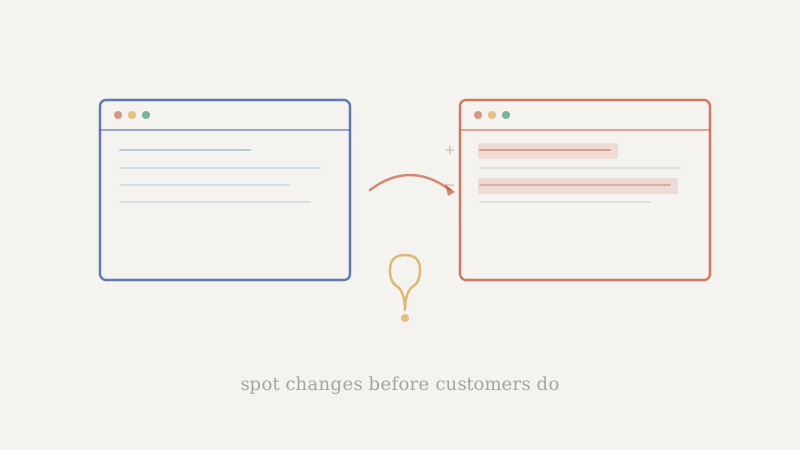
Competitor repositioning happens gradually. By the time a company announces a pivot, rebrand, or new market focus through a press release or blog post, the groundwork has been laid for weeks or months. The earliest signals of repositioning appear on their website long before any public announcement.
A headline change on their homepage. A new section on their pricing page. Updated language in their product descriptions. A new “Solutions” page targeting an industry they previously ignored. These small changes, individually unremarkable, collectively tell a story about where a competitor is headed. The companies that catch these signals early have weeks of advantage to adjust their positioning, arm their sales teams, and preempt competitive narratives.
What Website Changes Actually Signal
Not every website change is meaningful. Competitors update copy, swap images, and tweak layouts for reasons that have nothing to do with strategy. The skill is knowing which changes carry signal and which are noise.
Homepage headline and subheadline changes are high-signal. The homepage headline is the most deliberate piece of copy on any website. It goes through more review cycles and stakeholder debates than almost any other text. When it changes, someone made a strategic decision about how the company wants to be perceived. Track exact wording changes over time. A shift from “The leading CRM for small business” to “The revenue platform for growing teams” tells you they are moving upmarket and broadening their value proposition.
Pricing page restructuring is almost always strategic. New tiers, renamed plans, changed feature allocations, and new add-ons reveal product strategy. If a competitor adds an “Enterprise” tier they did not have before, they are moving upmarket. If they introduce a free tier, they are shifting toward product-led growth. If they bundle features that were previously add-ons, they are responding to competitive pressure on pricing.
New landing pages for specific industries or use cases. When a competitor creates a dedicated page for “Healthcare” or “Financial Services” or “Manufacturing,” they are investing in vertical positioning. This is particularly useful intelligence for sales teams because it tells you exactly which accounts the competitor is targeting.
Changes to integrations and partner pages. A competitor adding new integration partners signals their strategic ecosystem bets. If they add a CRM integration they previously lacked, or highlight a partnership with a data provider, it tells you which adjacent markets they are trying to serve.
Removal of pages or features is as telling as additions. When a competitor removes a product from their navigation, discontinues a feature, or quietly kills a pricing tier, they are making strategic cuts. These removals often signal a company narrowing focus, which creates opportunities in the spaces they are abandoning.
Building a Systematic Tracking Process
Manual competitor website monitoring does not scale. Checking five competitor websites daily for changes is tedious, inconsistent, and nearly impossible to maintain. You need a system.
Define What to Monitor
Start by identifying the specific pages on each competitor’s website that carry the highest signal:
- Homepage (headline, subheadline, hero section)
- Pricing page (tiers, features, pricing model)
- Product or features page (capabilities, messaging)
- Solutions or use cases pages (vertical and horizontal positioning)
- Integrations page (ecosystem partnerships)
- About or company page (mission statement, team changes)
- Blog (content themes, publication frequency, keyword targeting)
For most competitors, this is 5 to 10 URLs per company. If you are tracking three to five competitors, that is 25 to 50 URLs total.
Set Up Automated Change Detection
CAM monitors competitor websites and alerts you when changes occur, so you do not need to manually check pages. Configure monitoring for your priority URLs with alert thresholds that filter out cosmetic changes (image swaps, footer updates) and surface meaningful content modifications.
For teams that want additional context around changes, pair website monitoring with LinkedIn activity tracking. A competitor updating their homepage messaging while simultaneously posting LinkedIn content about a new market direction confirms the repositioning signal is real and intentional.
Create a Change Log
Every meaningful change should be logged with the date, the specific change, and your interpretation of what it signals. Over weeks and months, this log reveals patterns that individual changes cannot.
For example, a competitor might update their homepage headline in January, add a new enterprise pricing tier in February, and create three new vertical landing pages in March. Individually, each change is interesting. Together, they tell a clear story: the company is moving upmarket to sell to larger organizations in specific industries.
Turning Website Intelligence into Sales Ammunition
Raw change data has limited value. The value is in how your sales and marketing teams use it.
Update competitive battlecards within 48 hours of meaningful changes. When a competitor changes their pricing, messaging, or feature positioning, your sales team needs updated talking points before their next competitive deal. Battlecards that reference last quarter’s competitor positioning are worse than no battlecards at all.
Build “why us” narratives around competitor gaps. When a competitor removes a feature, discontinues a product, or narrows their focus, create specific messaging for prospects in the spaces they are abandoning. “Competitor X recently deprecated their analytics module” is a concrete, verifiable claim that gives your AE credibility in competitive deals.
Use repositioning signals to prioritize accounts. If a competitor is clearly moving upmarket and targeting enterprise accounts, their SMB customers may be feeling neglected. Arm your SDR team to target those accounts with messaging that addresses the concern: “As [Competitor] focuses more on enterprise, we are doubling down on serving teams like yours.”
Feed signals into outbound sequences. When your outreach platform (whether managed through Vendisys or run internally) targets accounts that overlap with a repositioning competitor, incorporate the competitive context into your messaging. A cold email that references a specific, recent change at their current vendor is more credible than generic competitive claims. Make sure you validate the contact data before launching those sequences; running prospect lists through Scrubby for catch-all verification ensures your outreach actually reaches the target.
Brief your marketing team for content counter-positioning. When a competitor shifts messaging toward a specific narrative, your content team should be prepared with counter-positioning. If a competitor starts emphasizing “all-in-one” platform messaging, your content should articulate why specialized tools outperform bundled solutions (or vice versa, depending on your positioning).
Patterns That Predict Major Moves
Certain combinations of website changes reliably predict larger strategic moves. Watch for these patterns across your competitor tracking:
Rapid messaging iteration signals uncertainty. If a competitor changes their homepage headline three times in two months, they have not found product-market fit for their new positioning. This is a vulnerability. Their sales team is operating with inconsistent messaging, and their prospects are confused about what the company actually does.
New hiring pages plus new solutions pages signal expansion. When you see new “we’re hiring” pages for roles in a new department or function combined with new solutions pages targeting a new market, the competitor is investing in expansion. You have a window before their new offering is mature enough to compete effectively.
Pricing simplification signals maturity or desperation. Companies that consolidate pricing tiers, remove add-ons, and simplify their pricing page are either maturing their GTM motion (good for them) or trying to remove purchase friction because deal velocity has slowed (good for you). Context from other signals (LinkedIn activity, hiring patterns, review site sentiment) helps you determine which scenario applies.
Removal of competitive comparison pages signals retreat. If a competitor takes down their “Us vs. Them” pages, they may be losing competitive deals and deciding that direct comparisons draw attention to their weaknesses rather than their strengths. This is an opportunity to create your own comparison content that fills the vacuum.
Monitoring Is Not Optional
In a competitive market, the companies that win are not necessarily the ones with the best product. They are the ones with the best intelligence about how the market is shifting and the ability to respond before competitors’ moves are fully realized.
CAM gives you the infrastructure to track competitor changes automatically, so your team can focus on interpreting signals and acting on them rather than manually checking websites. Combined with outbound tools like Kali for reaching the right accounts at the right time, competitor intelligence becomes a systematic advantage rather than an occasional exercise.
Track the changes. Read the patterns. Move before they announce.