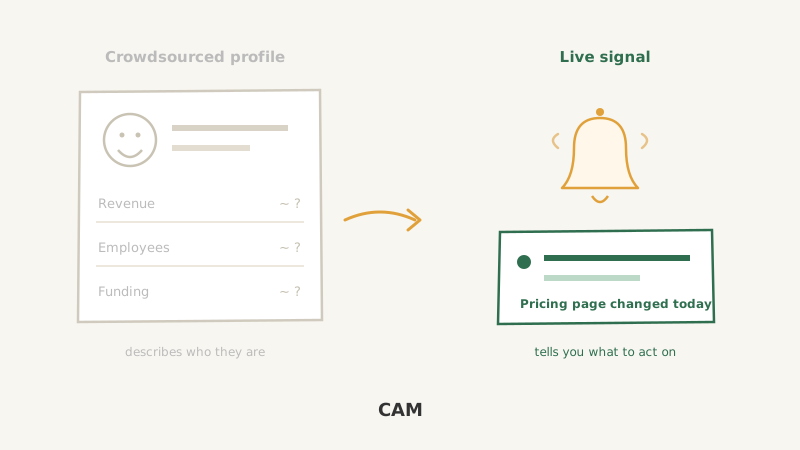
If you have searched for a way to keep tabs on competitors, Owler probably came up fast. It built its reputation on crowdsourced company profiles, daily news digests, and high-level data like estimated revenue, employee counts, funding, and acquisitions. Now part of Meltwater, it gives sales and marketing teams a quick read on who a company is and what is happening around it.
That is genuinely useful for research. The question worth asking before you standardize on it is whether company profiles and news roundups are the same thing as the competitive signals your team acts on. They are not. Knowing a competitor’s rough headcount or that they appeared in a press release is background. Knowing that they just changed their pricing page, shipped a new feature, opened ten enterprise sales roles, or quietly rewrote their homepage positioning is a signal you can build a play around.
This post covers what Owler does well, where a profile-and-news model leaves gaps for teams that sell against competitors, and how CAM delivers the change-level signals teams actually move on.
What Owler Does Well
Owler earned its place in the category for real reasons:
- Crowdsourced company profiles. It aggregates community-contributed data into a quick snapshot of any company, including estimated revenue, headcount, and top competitors.
- News and event alerts. It pushes daily digests covering funding rounds, acquisitions, leadership moves, and press mentions across the companies you follow.
- Breadth of coverage. With millions of company profiles, it is easy to look up almost any business and get a baseline read.
- Meltwater ecosystem. As part of Meltwater, it connects to a wider media-monitoring and PR suite.
If your main need is fast company research and a news feed about who is in the market, Owler covers that well. The catch shows up when you need to act on what a specific competitor is doing, not just read about who they are.
Where a Profile-and-News Model Leaves Gaps
The same model that makes Owler easy to browse limits it as an operational competitive tool:
- Profiles describe, signals trigger. Estimated revenue and headcount tell you the shape of a company. They rarely tell you what changed this week or what to do about it. Sales motions run on changes, not static stats.
- Crowdsourced data ages. Community-contributed figures can be stale or imprecise. For background that is fine. For a decision about how to position against a live deal, approximate numbers are thin ground.
- News coverage skews to big events. Funding and acquisitions make the digest. The quiet pricing-page edit, the new comparison page targeting your product, the hiring surge in a specific function, often do not. Those subtle moves are exactly the ones that predict where a competitor is heading.
- Reading is not acting. A daily news roundup is something to skim. It does not arrive scoped to your competitors with the context a seller needs to respond the same day.
The familiar pattern is a team that subscribes for company research, then realizes the feed tells them a competitor raised a round but never tells them that competitor just launched the feature their biggest prospect keeps asking about.
What CAM Does Instead
CAM starts from a different premise. The point is not to describe a company. It is to catch the changes a competitor makes and put them in front of you while they still matter.
You point CAM at the competitors you care about, and it watches the public signals that move decisions:
- Pricing page changes and new plan tiers
- New features, product launches, and changelog updates
- Hiring surges and job-posting patterns that hint at roadmap and expansion
- Positioning and messaging shifts across the website
- New customer logos, case studies, and comparison pages aimed at you
When something changes, CAM tells you, with enough context to act, the day it happens. There is no profile to maintain, no digest to wade through, and no waiting on crowdsourced data to catch up. The signal lands already filtered to changes worth your attention.
Owler vs CAM at a Glance
| Owler | CAM | |
|---|---|---|
| Built for | Company research and news browsing | Acting on competitor changes |
| Core data | Crowdsourced profiles and news | Live website and signal monitoring |
| Freshness | As current as the community keeps it | Detected when the change happens |
| Output | Profile pages and daily digests | Scoped change alerts with context |
| Best fit | Background research on any company | Sales and marketing teams selling against named competitors |
When Owler Is Still the Right Call
If your team mostly needs to look companies up, get a quick read on size and recent press, and skim a market news feed, Owler does that job and its breadth is hard to beat. Research-heavy roles and PR teams inside the Meltwater ecosystem will get real value from it.
CAM is the better fit when your competitors are named and few, and when the work is responding to what they do rather than reading about who they are. A reposition, a price change, or a feature launch from a direct rival is a reason to update a battlecard, brief the sales team, or reach back into a stalled deal. That is the moment CAM is built for.
Build the Full Signal Stack
Competitor monitoring is one input to a sales motion, not the whole thing. Once a competitor signal tells you a deal is back in play, the next steps still have to land. Reaching the right contacts means your outreach list has to be clean, so a verification tool like Scrubby keeps bounces down before you send. Getting the meeting booked is its own step, where calendar-first outreach from a tool like Kali turns a warm signal into a scheduled call. The signal from CAM is the trigger; the rest of the stack turns it into pipeline.
If you have been evaluating Owler and what you really want is to know the moment a competitor moves, that is the gap CAM was built to close. See how it works at getcam.io.