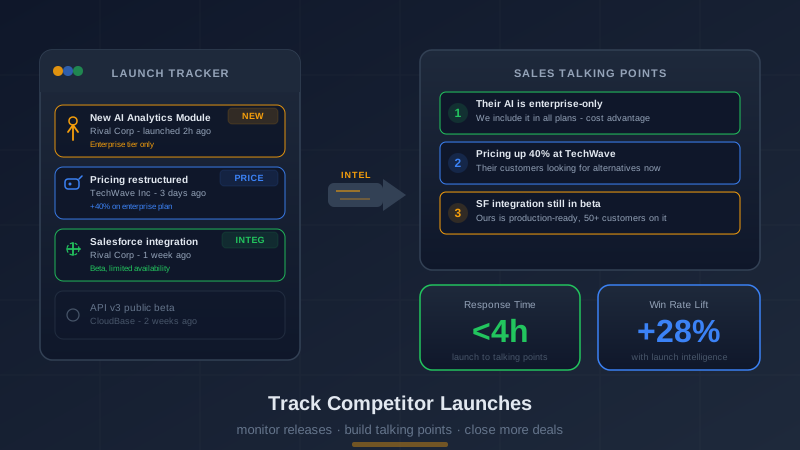
Your competitor just shipped a major feature. Your biggest prospect saw the announcement on LinkedIn twenty minutes ago. Your AE has a call with that prospect tomorrow morning.
Does your AE know about the launch? Do they have a response ready? Can they articulate exactly why your product is still the better choice, or are they going to get blindsided on a live call?
For most sales teams, the honest answer is uncomfortable. Competitor launches catch them off guard. Reps scramble. Messaging is inconsistent. And by the time leadership puts together an official response, the window of maximum impact has already closed.
It does not have to work this way. The teams that win competitive deals consistently treat competitor launches not as threats, but as some of the best sales opportunities they get all quarter.
Why Competitor Product Launches Create the Best Sales Windows
When a competitor ships something new, three things happen simultaneously that work in your favor.
Prospects start re-evaluating. A new feature announcement reminds every prospect in your pipeline that alternatives exist. But it also reminds them to compare. If your product already does what the competitor just launched, or does it better, a launch announcement is actually a trigger for prospects to appreciate your existing strengths.
Competitor messaging reveals their positioning gaps. Launch announcements are marketing documents. They tell you exactly how the competitor thinks about their product, which use cases they are targeting, and which customers they are trying to attract. That information is pure gold for your sales team.
Current competitor customers feel the friction. New product launches often mean new pricing tiers, forced migrations, changed workflows, or features locked behind higher plans. The 48 hours after a major launch is when competitor customers are most likely to be frustrated, confused, or open to hearing about alternatives.
The problem is that most of this value evaporates within a week. The window where prospects are actively re-evaluating is short. If your sales team does not have talking points ready within hours of a competitor launch, you have missed the best opportunity.
Setting Up Systematic Monitoring for Competitor Announcements
Manual monitoring does not work. Checking competitor blogs and Twitter feeds once a week means you are always days behind. Here is what a reliable monitoring system looks like.
Layer 1: Direct Source Monitoring
Start with the channels competitors use to announce product updates:
- Product blogs and changelogs. Most SaaS companies have a dedicated changelog or product updates page. Set up RSS monitoring for each competitor’s blog.
- Press and media coverage. Google Alerts still works for catching major announcements that hit industry publications.
- Social accounts. Competitor Twitter/X accounts, LinkedIn company pages, and founder personal accounts are often where news breaks first.
This layer catches the big, public announcements. But it misses the signals that happen before and around launches.
Layer 2: Signal Monitoring
The most valuable intelligence often comes from indirect signals, not press releases. These include:
- LinkedIn activity changes. When a competitor’s product and engineering team suddenly starts posting more frequently, a launch is usually imminent. When their sales reps start sharing feature-focused content, the launch has happened and they are already selling against you.
- Job posting shifts. A competitor hiring solutions engineers or customer success managers for a new product line tells you something is coming before the official announcement. Tools like CAM can surface these LinkedIn activity shifts automatically, flagging when competitor employees change their posting patterns or when new roles appear that signal upcoming launches.
- Prospect behavior changes. If several prospects in your pipeline suddenly go quiet or start asking pointed feature questions, someone is talking to them about a new competitive offering.
Layer 3: Community and Customer Signals
- Review sites. G2, Capterra, and TrustRadius reviews often mention new features within days of launch, and they include candid customer reactions that the competitor’s marketing will never show you.
- Community forums. Slack communities, Reddit threads, and industry Discord servers surface real user reactions faster than any other channel.
- Conference and event mentions. Competitors often soft-launch features at industry events before the public announcement.
The key is consolidating all of these signals into a single feed your team actually checks. A Slack channel dedicated to competitive intelligence, updated automatically, is far more effective than a shared Google Doc that no one opens.
Turning Launch Intel Into Differentiation Talking Points
Raw intelligence is useless to a sales rep on a call. They need specific, concise talking points they can use in conversation. Here is the framework for converting a competitor launch into actionable sales ammunition within hours.
Step 1: Categorize the Launch
Every competitor launch falls into one of four categories, and each requires a different response:
| Launch Type | Your Response |
|---|---|
| Feature you already have | Emphasize your maturity and production readiness |
| Feature you do not have | Acknowledge and redirect to your unique strengths |
| Pricing or packaging change | Quantify the cost impact on prospects |
| New market or vertical entry | Highlight your established presence and customer proof points |
Step 2: Write the Three-Sentence Brief
For each launch, produce a brief with exactly three components:
- What they shipped. One sentence, factual, no spin.
- What it means for prospects. One sentence on how this changes the competitive landscape.
- Our differentiation. One sentence on why our approach is better for the prospect’s specific situation.
This format works because it is short enough for a rep to read two minutes before a call and long enough to be genuinely useful.
Step 3: Build the Objection Response
Assume that within 48 hours of a competitor launch, at least one prospect will say: “I saw that [Competitor] just launched [Feature]. What do you think?”
Write the exact response you want your reps to give. Make it conversational, honest, and focused on the prospect’s outcomes rather than feature-for-feature comparison.
For example: “Yes, we saw that too. It is good validation that the market needs this capability. We have had [similar capability] in production for [timeframe], and what our customers tell us is that [specific outcome]. Happy to walk you through how [Customer X] uses it if that would be helpful.”
Briefing Your Sales Team When a Competitor Ships
Speed matters more than polish. Here is the process that high-performing competitive intelligence teams use.
Hour 1: Alert. Send a short notification to the sales team Slack channel. Just the facts: what was launched, where the announcement lives, and a one-line assessment of impact level (low, medium, high).
Hour 2-4: Brief. Distribute the three-sentence brief and the objection response. If the launch is significant, include a quick FAQ covering the two or three most likely prospect questions.
Day 2-3: Battlecard update. Update your formal competitive battlecard with the new information. This is where you add the detailed feature comparison, pricing analysis, and win/loss data.
Week 2: Retrospective. Track how many conversations referenced the competitor launch, what questions prospects asked, and how your reps performed. Feed this back into your process.
The critical insight is that most sales teams skip straight to the battlecard update, which takes days. By then, the initial window is gone. The alert and brief are what matter for the first 48 hours.
Using LinkedIn Signals to Find Prospects Evaluating Competitors
One of the most overlooked advantages of competitor launches is that they surface prospects who are actively evaluating alternatives. Here is how to find them.
Watch for new LinkedIn connections between prospects and competitor reps. When a prospect at a target account connects with three people at a competitor within a two-week window, they are in an active evaluation. This is exactly the kind of signal that CAM was built to detect. Rather than manually checking connection changes across hundreds of prospects, CAM monitors LinkedIn activity automatically and flags when target accounts start engaging with competitor employees.
Monitor engagement on competitor launch posts. Prospects who like, comment on, or share a competitor’s launch announcement are signaling interest. These are warm outreach targets.
Track competitor employee outreach patterns. When competitor SDRs suddenly increase their LinkedIn activity in a specific vertical or geography, it often coincides with a product launch targeting that segment. This is a signal to accelerate your own outreach in the same segment before the competitor gains traction.
If your team is also running cold email campaigns to these prospects, validating your contact data is critical. Bounced emails during a time-sensitive competitive window waste your best opportunities. Tools like Scrubby help ensure your prospect email lists are clean before you hit send, so your outreach actually lands when the timing matters most.
Building a Repeatable Launch Response Playbook
The goal is not to react to every competitor launch as a fire drill. It is to build a system that turns competitor launches into a predictable source of pipeline and wins.
Define your competitor tier list. Not every competitor deserves the same level of monitoring. Tier 1 competitors (direct, frequent deal overlap) get full monitoring across all layers. Tier 2 competitors (occasional overlap) get automated monitoring only. Tier 3 competitors (rare encounters) get quarterly reviews.
Assign ownership. One person should own the competitive intelligence feed. This is usually a product marketing manager or a sales enablement lead. Their job is not to do all the research, but to make sure alerts go out on time and briefs are written within the four-hour window.
Automate what you can. Manual monitoring does not scale past two or three competitors. Use tools that consolidate signals into a single view. CAM handles the LinkedIn and competitor activity monitoring layer automatically, surfacing connection changes, posting patterns, and engagement signals so your team can focus on building the talking points rather than hunting for raw data.
Measure impact. Track three metrics: time from competitor launch to sales team briefing, number of deals where competitive talking points were used, and win rate in deals where competitor launches were actively addressed versus ignored.
The 48-Hour Advantage
Competitor product launches are not threats. They are triggers. Every launch reshapes the conversation your prospects are having internally, and the sales team that shows up first with a clear, confident point of view wins that conversation.
The difference between teams that capitalize on competitor launches and teams that get caught flat-footed is not talent or budget. It is having a system that turns competitor activity into sales-ready intelligence before the window closes.
Build the monitoring layers. Write the briefs. Distribute them fast. And use the tools that automate the hardest parts of the process so your team can focus on what they do best: selling.